Freelancing Ka Complete Guide for Students
Keyword Optimization Errors and How to Avoid Them
Aqsa aqsa
October 16, 2025
Business & Technology
Aqsa aqsa
October 16, 2025
In the world of digital marketing, keyword optimization remains one of the most powerful tools for boosting online visibility, driving organic traffic, and improving search engine rankings. However, many businesses make critical mistakes that hurt rather than help their SEO strategy. In this article, we’ll explore the most common keyword optimization errors and share practical tips on how to avoid them to ensure your content ranks higher and converts better.
Keyword optimization is the process of researching, analyzing, and strategically using the right keywords in your content to attract the right audience. It’s not just about inserting keywords randomly—it’s about understanding user intent, aligning content with search behavior, and improving the overall SEO performance of your website.
One of the biggest mistakes marketers make is keyword stuffing—the excessive use of keywords throughout the content. This not only makes your article unreadable but also triggers Google’s spam filters, leading to ranking penalties.
Example: “Best shoes Pakistan best shoes price best shoes online Pakistan”
Solution: Maintain a 1–2% keyword density. Focus on using variations, synonyms, and natural language instead of repeating the same phrase.
Many businesses target keywords without considering what users actually want. For instance, someone searching for “best laptop 2025” is looking for reviews and recommendations—not technical specifications.
Solution: Understand the search intent behind a keyword (informational, navigational, commercial, or transactional) and create content that satisfies that intent.
Targeting keywords unrelated to your niche confuses both users and search engines. This reduces relevance and increases bounce rates.
Solution: Use keyword research tools like Google Keyword Planner, SEMrush, or Ahrefs to identify relevant, high-intent keywords directly related to your business or service.
Many marketers chase high-volume keywords that are too competitive. Ignoring long-tail keywords—more specific phrases—means missing out on targeted traffic that converts better.
Solution: Focus on long-tail keywords such as “best budget smartphone under 50000 in Pakistan” instead of just “smartphone.” These attract users closer to making a purchase decision.
Relying only on exact-match keywords limits your SEO potential. Google now uses semantic search to understand related topics and meanings.
Solution: Include LSI keywords—related words and phrases—to provide context and depth. For example, for “digital marketing,” LSI terms could include “SEO,” “social media marketing,” or “online branding.”
Even with great content, failing to optimize your meta title, meta description, and headers (H1, H2) weakens your SEO impact.
Solution: Ensure your primary keyword appears in:
Page title (within the first 60 characters)
Meta description (around 160 characters)
H1 and at least one H2 heading
Poor keyword placement can reduce SEO effectiveness. Dumping keywords in random sections or skipping them in crucial areas makes it harder for search engines to understand your content.
Solution: Place keywords naturally in:
Title tag
First 100 words of the content
Subheadings
Image alt text
URL and meta tags
Publishing optimized content isn’t the end—it’s just the beginning. Many businesses forget to track keyword performance and update underperforming pages.
Solution: Use tools like Google Search Console or Ahrefs Rank Tracker to monitor keyword rankings, CTR, and impressions. Regularly refresh old content with new data and trending keywords.
How can we help grow your business today?
Here’s a simple 4-step keyword optimization framework to follow in 2025:
Research Smartly: Use SEO tools to find low-competition, high-intent keywords.
Map Keywords to Content: Assign each page or post a primary keyword and several secondary keywords.
Optimize Naturally: Integrate keywords into the flow of content without compromising readability.
Analyze & Update: Continuously track performance and tweak keywords based on analytics.
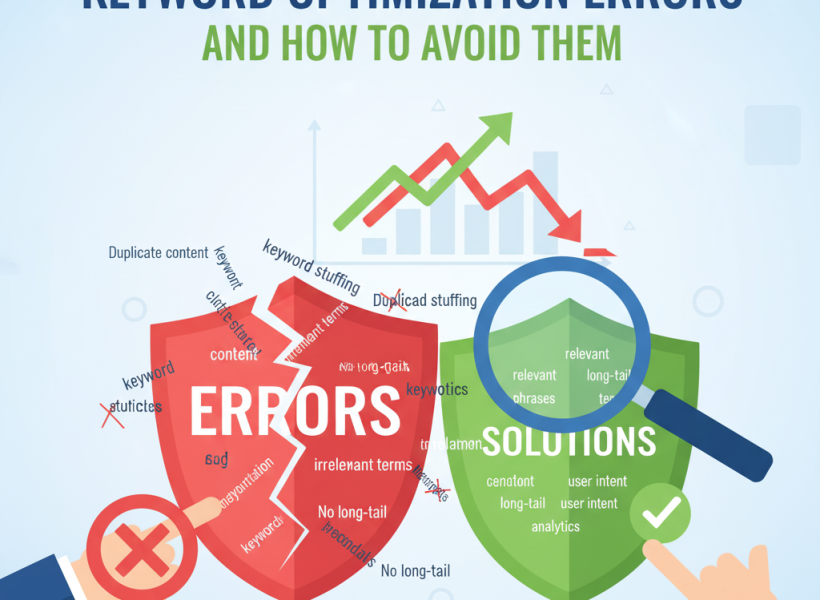
Avoiding keyword optimization errors is essential for sustainable SEO success. The key lies in balance—using keywords strategically while prioritizing user experience and content quality. Remember, modern SEO isn’t about tricking search engines; it’s about helping them understand your content’s value.
When you avoid these common mistakes and implement best practices, your website won’t just rank higher—it will attract the right audience, improve engagement, and boost conversions.
Our team helps businesses promote online through smart marketing strategies.