

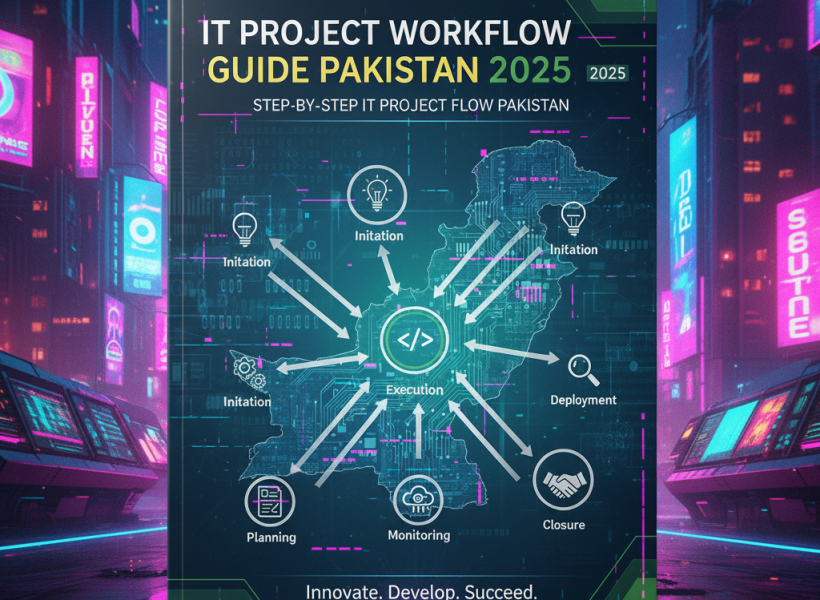
IT Project Workflow Guide Pakistan 2025 | Step-by-Step IT Project Flow Pakistan
Aqsa aqsa
October 23, 2025

In 2025, Pakistan’s IT industry is scaling rapidly. From startups to enterprise clients, the demand for structured, reliable and professional IT project delivery has never been higher. Whether you are a client outsourcing development to Pakistani IT teams or an agency managing complex software projects — success depends on a clear and disciplined IT Project Workflow.
This step-by-step guide explains a complete modern IT project lifecycle in Pakistan 2025, covering planning, design, development, testing, deployment and post-launch support — optimized for performance, quality, business ROI, and client satisfaction.
Requirement Gathering & Project Discovery
A successful IT project begins with clarity.
Actions performed in this phase:
Identify business goals & expected outcome
Stakeholder interviews & user persona mapping
Define modules, use-cases & success KPIs
Draft BRD (Business Requirements Document)
Estimate timeline, team size & cost
Identify constraints, dependencies & risks
Output: Scope Document, BRD, Project Charter, Budget Estimate
UX Flow, Wireframing & Prototype Design
Instead of jumping into coding, modern Pakistani IT teams translate ideas into visuals.
Key activities:
Create low fidelity wireframes to define layout
Develop clickable prototype in Figma / XD
Define UX journeys, navigation rules & states
Follow mobile-first & accessibility standards
Alignment meeting with stakeholders for approval
Output: Approved Prototype, UX Flow Chart, UI Guidelines
Technical Architecture & Technology Decisions
Poor technical decisions cause failure later. This phase locks the foundation.
Includes:
Backend architecture (Monolith / Microservices)
Tech stack selection (Laravel, Node, React, Next.js, etc.)
Database design & indexing strategy
Hosting & DevOps pipeline planning
API contracts, integration rules, security policies
Output: Architecture Diagram, DB Schema, API Specs, DevOps Plan
Agile Sprint-Based Development
Pakistan’s 2025 IT agencies follow Agile / Scrum for efficient delivery.
Typical sprint workflow:
Sprint Planning (1–2 weeks cycle)
Feature-wise coding & code review on Git
Daily stand-ups & blockers resolution
Sprint demo & feedback loop with client
Output: Source Code, Sprint Builds, Review Notes
Quality Assurance, Testing & Validation
Testing runs parallel — not after development.
Testing layers include:
Functional & regression testing
API & integration testing
Performance & load testing
Cross-browser & device testing
Security & penetration testing
UAT (User Acceptance Testing) with client
Output: Bug Reports, Test Sign-off, UAT Approval
Deployment, Stabilization & Go-Live
Once QA is clear, deployment moves in a controlled manner.
Activities include:
Setup of CI/CD pipeline (GitHub Actions / Jenkins)
Server provisioning (AWS / Azure / DigitalOcean)
SSL, firewall, domain & DNS configuration
Soft launch with monitoring window
Final public go-live
Output: Live System, Deployment Report, Rollback Strategy
Documentation, Training & Handover
Documentation ensures long-term usability and scalability.
Deliverables include:
Technical documentation & API docs
Admin/user manuals & SOPs
Environment details & access credentials
Handover meeting & training session
Support, Maintenance & Continuous Improvement
Maintenance is not optional — it is part of lifecycle.
Post-Go-Live actions:
Bug fixing & security patching
Performance optimization & scaling
Integrations & feature updates
SLA-based support plans for enterprise
How can we help grow your business today?
Triva spot
Why Structured IT Workflow Matters in Pakistan 2025
Eliminates time & budget overruns
Improves project transparency & trust
Enables higher quality & performance
Helps agencies win global clients
Reduces disputes & delivery risks
Common Problems Solved by Workflow
- Miscommunication → Fixed via documented approvals
- Scope creep → Controlled via change request process
- Delays → Avoided with sprints & daily standups
- Quality drop → Fixed via continuous QA & CI/CD
- Client dissatisfaction → Prevented with demo-based approvals
How long does a typical IT project take in Pakistan?
Small projects: 4–8 weeks, Medium: 3–6 months, Enterprise: 6–18 months based on complexity.
Which methodology is common in Pakistan 2025?
Agile/Scrum with CI/CD and automated deployment pipelines is standard.
Is documentation mandatory?
Yes — enterprise-grade clients require BRD, SRS, QA Reports, UAT and SOPs.
Final Thoughts
In 2025, the IT industry in Pakistan is no longer informal or guess-driven — the companies that are winning local and global projects are the ones following a disciplined, transparent and structured workflow. A step-by-step IT project process not only improves delivery speed and product quality, but also builds long-term trust with clients and reduces operational risks for IT teams.
Whether you are a client outsourcing a digital solution or an IT agency delivering software, this standardized workflow is your success factor. Projects fail when they start without documentation, run without sprints, deploy without QA, or launch without maintenance. But when every phase from requirement to support is handled systematically, the outcome is predictable, scalable and profitable for both sides.
Structured IT workflow is not just a technical practice — it is a business advantage.